Advancing reproductive healthcare for all: Our team at the International Conference on Family Planning
Written by Rebecca Harrington and Isabel Song | Published: December 6, 2025
The Population Connection Communications and Field teams were delighted to take part in the International Conference on Family Planning (ICFP), held in Bogotá, Colombia, from November 1-7.
After a long 10 months battling the Trump administration’s near-daily assaults on reproductive health and rights, it was such a relief to be surrounded by so many likeminded people—and to be outside of the US!
Hospital site visits
The conference kicked off with memorable site visits to two public hospitals in Bogotá: Kennedy Hospital and Jorge Eliécer Gaitán Hospital.

At Kennedy Hospital, we were given a tour of the labor and delivery wing, to learn about the unit’s birthing, breastfeeding, and abortion care services. With a backdrop of grunts and screams of actively laboring patients—there is not always enough anesthesia medication available for all patients—we learned from the hospital’s obstetric and gynecologic staff about their maternal health care and the readily available abortion care they give to patients, who range in age from 10 to 50. (This lack of available anesthesia has resulted in a high C-section rate, as many women elect for the procedure to guarantee access to the medication.)
Since 2022, Colombia has had a liberalized abortion law that allows abortions up to 24 weeks (about 5 and a half months) of gestation, for any reason, and the Kennedy OB/GYN staff is focused on providing stigma-free care to all who need it. All patients who come seeking an abortion are provided with one, whether by medication or manual vacuum aspiration, and are scheduled for follow-up care.
In addition to abortion services, the staff provides contraceptive care, emphasizing long-lasting options such as implants and IUDs to patients. They educate 100% of patients who come in for reproductive health services on contraception, and 99% of patients who want to start birth control leave the hospital with the method of their choice that same day. These contraceptive services — including vasectomies — are provided free of charge.
The OB/GYN staff at Kennedy discussed a whole range of comprehensive reproductive care, in addition to the abortion and birthing care provided at the center.
Colombia has a high rate of syphilis, which the staff said is due to a lack of education, low use of barrier methods, and re-infection from untreated partners. All of their patients therefore are provided with a dual rapid test for HIV and syphilis.
At Jorge Eliécer Gaitán, we learned that the hospital provides 24/7 stigma-free abortion care and performs 2,000 abortions per year. Additionally, 100% of patients leave the hospital with a long-acting method of contraception.
We were fortunate to spend time with Dr. Jorge Eduardo Caro, an abortion provider who was involved in advocating for the 2022 law that liberalized abortion in Colombia.
Dr. Caro deeply inspired us with his commitment to providing abortion care and advocating for abortion rights, with his motto of “first the woman, second the woman, and third the woman.”
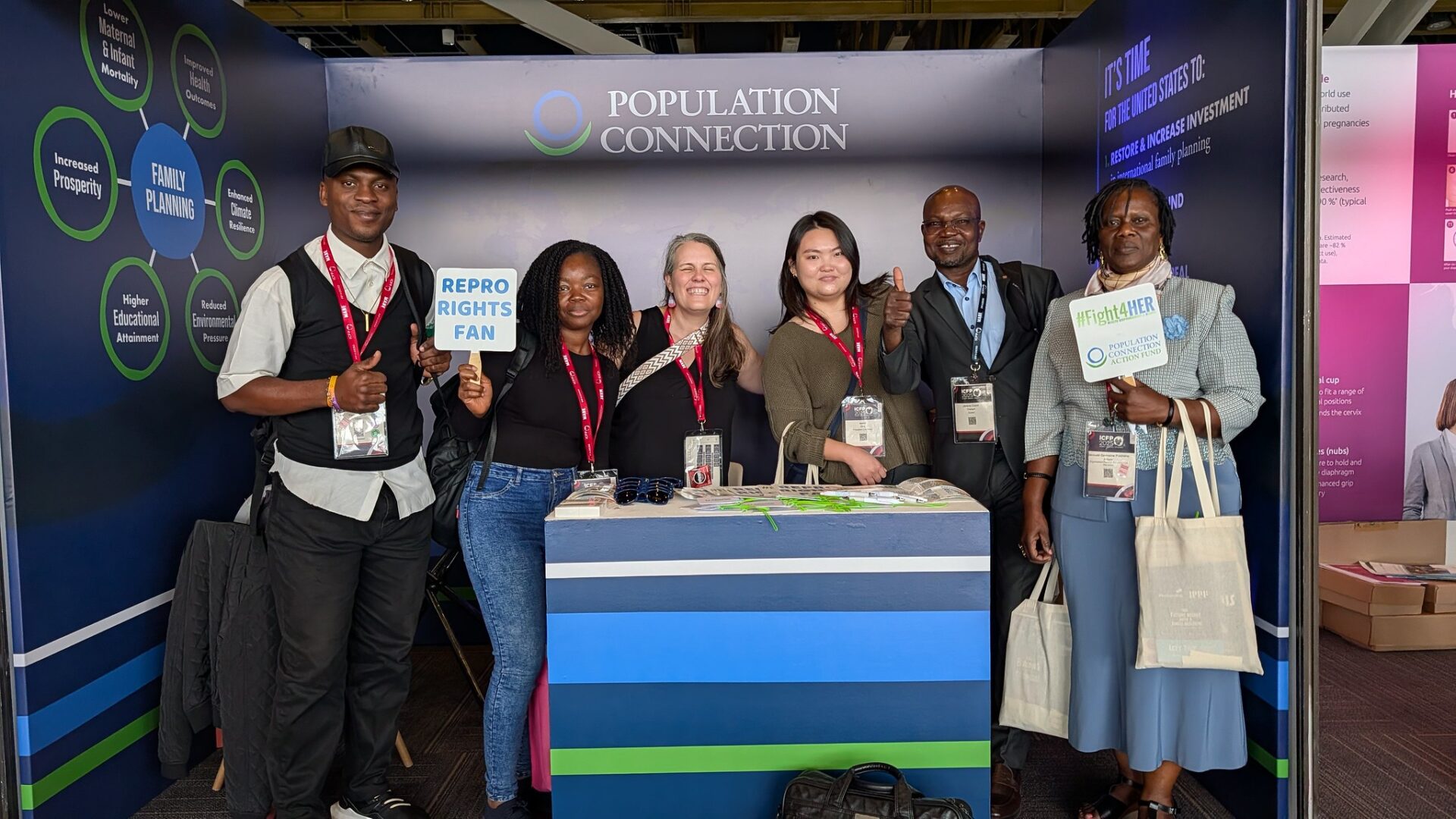
Our booth
With a grounding in the abortion and reproductive rights landscape in Colombia, we left the site visits ready to host our exhibit booth at ICFP. The conference kicked off with an opening ceremony, musical performances, and a lively reception.
We spoke with hundreds of people about their organizations’ family planning, comprehensive sexuality education, and HIV programs, and the universal damage the Trump administration is wreaking around the world. Conference goers nearly cleaned us out of our giveaways, with our luggage tags, tissues, and “Repro Rights Fan” hand fans being crowd favorites.
“I was so happy to see that part of your materials address the Global Gag Rule. I worked on the impact of the GGR in Trump 1 and in Trump 2, and it’s almost the same story. What makes it more complex now is that people are more radical, but we have stronger connections to see how these impacts are playing out in Africa.” – Dr. Moses Mulumba, Director General, Afya na Haki
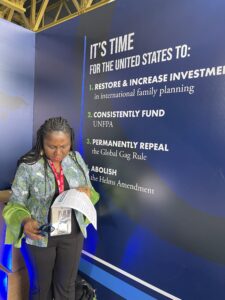
Roseline Achola, who previously worked with UNFPA for about 12 years, was equally impressed with our booth wall cover, especially point number 2, which states, “Consistently fund UNFPA”.
“I love this because the work that UNFPA is doing in this world is great — most especially family planning.” – Roseline Achola, Ministry of Health, Uganda
The same point caught the attention of Dela from UNFPA Ghana.
“It’s great that you are advocating for the great work that UNFPA is doing to continue investing in women and girls. If women and girls are prioritized, I think the world is going to be better place. We hope there will be success at the end of the road for all of us.”
We connected with people eager to be storytellers about their on-the-ground programs, and our social media following got a welcome boost from all the traffic at our booth. We met people from all over the world throughout the week, including from Ghana, Nepal, Uganda, Egypt, and Kenya. They shared stories with us about clinics closing, the struggle to replace US foreign aid funding, and the continued perseverance of communities determined to close gaps in reproductive care.
Inspiring sessions
Outside of the exhibit hall, we attended several moving sessions. One of these was a tribute to the United States Agency for International Development (USAID), with reflections from former heads of the Office of Population Affairs and country staff from around the world. They shared their unshaken belief that USAID programs made a huge difference worldwide and referenced a June 2025 Lancet study which estimates that over the agency’s 60-year existence, USAID programs saved 91 million lives.
When asked what USAID meant to them, staffers described the agency as “transparent” and as creating “community.” One staffer described the agency as a “very strong, powerful machine that integrated health, education, agriculture, and governance, linking all of those together to make a lasting impact.”
We also attended sessions on resisting the global anti-rights movement, which contextualized the regression happening in the US and abroad, as well as efforts to provide reproductive care for some of the most marginalized communities in the world — such as Palestinian women living under occupation and disabled youth in Uganda.
Another session provided an overview of exemplars in youth reproductive health, examining successes in Nepal — where adolescent fertility rates have significantly declined in the past 20 years with strides in girls’ education and comprehensive sex education — and elsewhere to identify driving forces in improving youth reproductive care and reducing adolescent pregnancy.
Our continued fight
We left Colombia inspired and refueled to continue fighting for global reproductive rights. While we heard so much about the devastating consequences of the Trump administration’s actions, we were also motivated by stories from people who are continuing to fight to improve comprehensive reproductive care access globally.
As we head into 2026, we will be considering how best to amplify the voices of all the incredible colleagues we met in Colombia, and how best to push international family planning up the political priority list as we approach the 2026 midterms.